
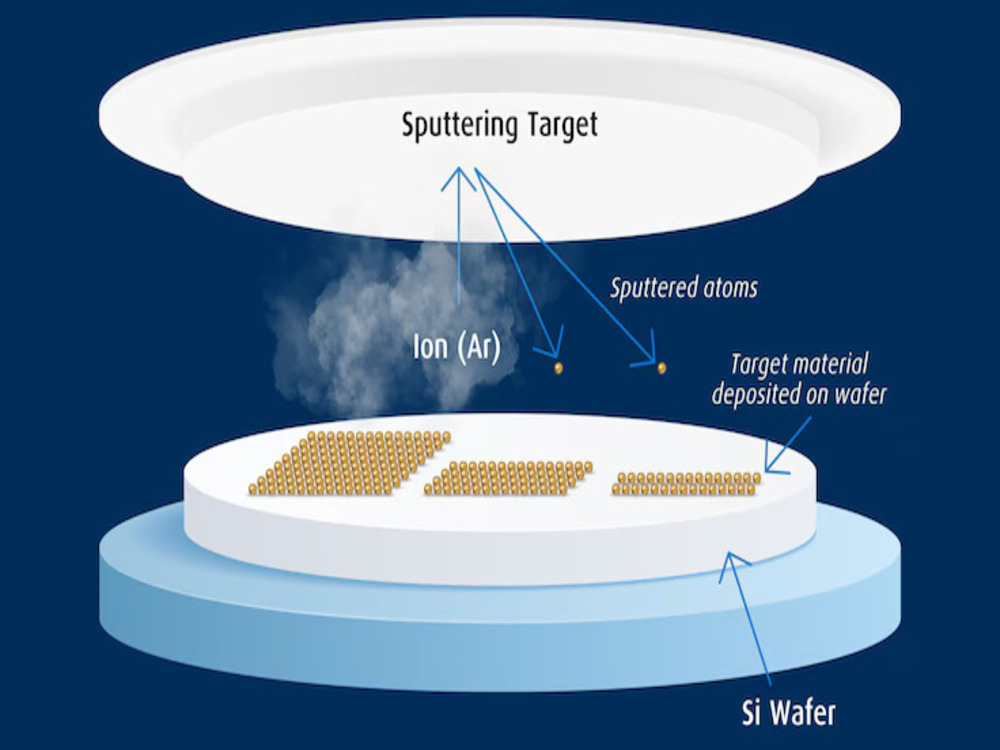
Introduction
The composition of sputtering targets assists in analyzing the thin film’s surface morphology, transmittance, electrical behavior, and crystal structure. Also, by controlling the composition of the sputtering target, manufacturers can achieve the desired product as required for their process. This article discusses the different compositions of the sputtering targets, taking boron-doped zinc oxide thin film prepared by different ceramics compositions as an example.
Co-sputtering and Compound Target Sputtering
The ZnO: B films deposited using magnetron sputtering provide low resistivity, dense structures, and good transmittance. Moreover, they offer high deposition rates and large deposition areas, making them suitable for mass production. ZnO: B film deposition happens using two sputtering targets(co-sputtering) or with a single compound target. Experimental data proves that the films deposited through co-sputtering are not uniform, and their properties are inferior to those deposited by the compound target. Hence, the preferred sputtering method is compound targets for depositing ZnO-based TCO films.
The ZnO: B film’s optical and electrical properties depend on boron doping. The ceramic target composition is crucial in determining the ZnO: B characteristics. Due to its smaller radius, the B3+ ions act as donors at the ZnO lattice’s substitutional or interstitial sites. While B3+ ions can be carriers in the films, excessive boron doping might negatively affect the electrical properties. In this study, we fabricate ZnO–B₂O₃ ceramic targets with varying levels of B₂O₃ content. We will examine how the boron concentration influences the material characteristics and electrical behavior of ZnO: B films, considering the composition of the sputtering targets.
Composition of the Sputtering Target
Boron-doped zinc oxide (ZnO: B) thin films were created using radio frequency magnetron sputtering from ceramic targets with varying compositions of (100 − x)ZnO–xB2O3 (where x = 0, 1, 2, 3, 4, 5, 7, and 10 wt.%). The study reveals that the boron concentration in the ceramic targets significantly influences the films’ surface morphology, crystal structure, transmittance, and electrical properties. The ZnO: B film was produced with a 3 wt.% B2O3 target demonstrated the lowest resistivity at 5.65 × 10⁻³ Ω cm and achieved a visible transmittance of 90%.
The initial materials are 99.99% pure ZnO powder and 99% pure B2O3 powder. After grinding and sieving, the particle size of both powders is 60 mesh. Then, both powders are mixed using ball milling. The milling is done with different B2O3 contents weighing 0 to 10%. Later, these powders are pressed uniaxially into a cylindrical pellet at 18kg/mm2 of pressure under room temperature. The diameter and thickness of the cylindrical pellet are 50.4 mm and 5.5 mm, respectively.
Characteristics of (100 − x)ZnO–xB2O3 Ceramic Targets
(100-x)ZnO-xB2O3 ceramic targets are dependent on B2O3 contents. With no B2O3 additives, the ceramic target made of undoped ZnO consists of tiny sintered particles of sizes between 2 and 8 μm. Further, on adding B2O3 of 1% wt, the sintered particle size in the target increases to 10-80 μm.
Applications
- Targets produced using alloys or doped materials are applied in semiconductor industries to attain the desired electric properties and performance.
- Targets made using different compositions help create anti-reflective and reflective coatings used in optical devices.
- Targets created using titanium nitride or zirconium nitride compositions are used to develop wear-resistant coatings for tools and industrial parts, extending their lifespan.
- Targets composed of conductive oxides help produce thin film transistors in displays and solar cells.
Conclusion
In conclusion, the properties of the boron-doped zinc-oxide (ZnO: B) ceramic target significantly influence the properties of the resulting thin film. By varying the boron content, we found that the 3 wt.% B2O3 target produced films with optimal characteristics, where 5.65 × 10⁻³ has a low resistivity of Ω cm and high visual transmittance of 90%. The results also confirmed the advantage of using compound targets in co-sputter processes since they gave more homogeneous films with better performance. Furthermore, investigating sintering behavior showed that increased boron content results in larger particles that can influence the film properties. Overall, this study highlights the importance of preparing sputtering target compositions to enhance the electro-optical properties of ZnO: B films.









Related Posts
What is Sputtering? Understanding the Process and Applications
Grain Size and Morphology: Exploring Their Impact on Material
Superconducting Insulating Materials & Polymer Insulation