
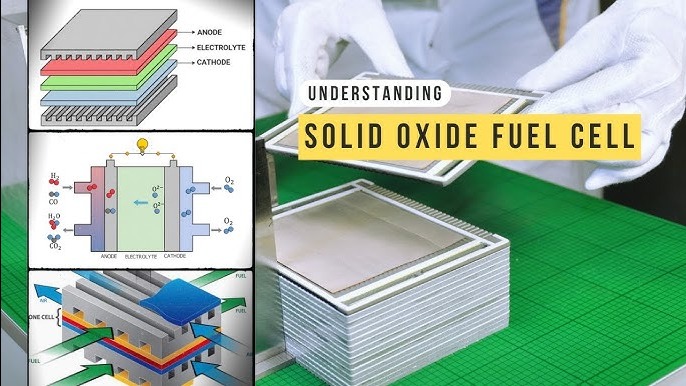
Solid oxide fuel cells (SOFCs) are a promising technology for efficient, low-emission energy conversion. Central to SOFC performance are the cathode materials, which play a crucial role in the electrochemical reactions that generate power. In this article, we will delve into the various types of solid oxide fuel cell cathode materials, their properties, and the latest advancements in this field. Whether you are a researcher, an engineer, or simply someone interested in cutting-edge energy solutions, understanding these materials can provide valuable insights into the future of fuel cell technology.
Infinita Materials specializes in both custom and standard oxide powders, such as cobalt oxide-based powders, inks, and other components of solid oxide fuel cells, which are available in its fuel cell store.
Understanding Solid Oxide Fuel Cells (SOFCs)
Solid oxide fuel cells operate at high temperatures, typically between 600°C and 1000°C. They convert chemical energy from a fuel directly into electrical energy through electrochemical reactions. The primary components of a SOFC fuel cell include an anode, a cathode, and an electrolyte. The cathode is particularly critical because it reduces oxygen molecules, which then react with the fuel at the anode to generate electricity.
High Temperature Operation
The high operating temperature of SOFCs offers several advantages. It allows for the use of non-precious metal catalysts, reducing costs. High temperatures also improve the kinetics of the electrochemical reactions, enhancing efficiency. However, it poses challenges in terms of material stability and thermal management.
Electrochemical Reactions
In SOFCs, electrochemical reactions occur at the anode and cathode. At the anode, the fuel undergoes oxidation, releasing electrons. These electrons travel through an external circuit to the cathode, where they reduce oxygen molecules. This process generates electrical power and heat as byproducts.
Key Components
The anode, cathode, and electrolyte are the critical components of an SOFC. The anode typically consists of a ceramic-metal composite, facilitating fuel oxidation. The electrolyte, usually a dense ceramic, conducts oxygen ions. The cathode provides active sites for oxygen reduction, making its material properties crucial for overall cell performance.
Applications of SOFCs
SOFCs are versatile and can be used in various applications, from stationary power generation to portable devices. They are particularly suitable for combined heat and power (CHP) systems, where both electricity and usable heat are produced. Their high efficiency and low emissions make them ideal for clean energy solutions.
Types of Cathode Materials
The choice of cathode material significantly impacts the efficiency, durability, and overall performance of an SOFC. Several types of cathode materials exist, each with its own set of properties and advantages.

“SEM micrograph of a PEMFC MEA cross-section with a non-precious metal catalyst cathode and Pt/C anode”, by Xi Yin / CC BY-SA 4.0
Lanthanum Strontium Manganite (LSM)
Lanthanum Strontium Manganite (LSM) is one of the most widely used cathode materials for SOFCs. It is known for its excellent thermal stability and good electronic conductivity. However, LSM has limitations in terms of oxygen ion conductivity, which can affect the fuel cell’s overall performance.
Thermal Stability of LSM
LSM’s thermal stability makes it suitable for high-temperature operations. It can withstand prolonged exposure to high temperatures without significant degradation, which is essential for maintaining consistent performance over the cell’s lifespan.
Conductivity Limitations
While LSM offers good electronic conductivity but relatively low oxygen ion conductivity. This limitation can hinder the overall efficiency of the SOFC. Researchers are exploring ways to enhance LSM’s ionic conductivity through doping and composite materials.
Applications of LSM
LSM is commonly used in high-temperature SOFCs, particularly in stationary power generation. Its stability and conductivity make it a reliable choice for long-term applications. However, its limitations necessitate the development of alternative materials for broader use cases.
Cobalt-based Oxides
Cobalt-based oxides, such as Lanthanum Strontium Cobalt Ferrite (LSCF), are gaining popularity due to their superior ionic and electronic conductivity. These materials can operate efficiently at lower temperatures than LSM, making them suitable for a broader range of applications.
Superior Conductivity
Cobalt-based oxides offer both high electronic and ionic conductivity. This dual conductivity enhances the efficiency of the oxygen reduction reaction, improving overall cell performance. These materials are particularly effective at intermediate temperatures.
Lower Temperature Operation
The ability to operate at lower temperatures broadens the applicability of cobalt-based oxides. Lower temperatures reduce thermal stress on materials, potentially extending the cell’s lifespan. This makes them attractive for applications where high-temperature operation is less feasible.
Challenges and Innovations
Despite their advantages, cobalt-based oxides face challenges such as cost and stability. Cobalt is expensive, and its long-term stability under operating conditions needs improvement. Ongoing research focuses on addressing these issues through material optimization and innovative manufacturing techniques.
Perovskite Oxides
Perovskite oxides are another class of cathode materials that have shown promise in SOFC applications. Materials such as Barium Strontium Cobalt Iron Oxide (BSCF) exhibit high ionic and electronic conductivity and good thermal stability. They are particularly effective at intermediate temperatures (500°C —700°C), which can reduce material costs and improve system longevity.
High Conductivity and Stability
Perovskite oxides combine high ionic and electronic conductivity with good thermal stability. This combination makes them highly efficient for oxygen reduction reactions. Their stability at intermediate temperatures enhances durability and reduces material degradation.
Cost and Efficiency Benefits
Operating at intermediate temperatures can lower material costs and improve efficiency. It allows for using less expensive materials and reduces the need for complex thermal management systems. This cost-effectiveness makes perovskite oxides attractive for commercial applications.
Research and Development
Research on perovskite oxides focuses on optimizing their composition and structure. By fine-tuning the material properties, researchers aim to further enhance conductivity and stability. Further, the advances in this area could lead to more efficient and durable SOFCs.
Custom Compositions and Inks
Advancements in material science have led to the development of custom compositions and inks for SOFC cathodes. These custom materials are designed to optimize specific properties, such as conductivity and stability, to meet the unique requirements of different applications. Custom inks can be tailored to enhance the performance of existing cathode materials or create entirely new compositions that offer superior characteristics.
Tailored Properties
Custom compositions and inks allow for the precise optimization of material properties. By adjusting the composition, researchers can enhance attributes like conductivity, stability, and compatibility with other components. This customization leads to improved performance and longevity.
Enhancing Existing Materials
Custom inks can enhance the properties of existing cathode materials. For example, adding specific dopants can improve conductivity or stability. This approach allows for incremental improvements without the need for entirely new materials.
Creating New Compositions
Material science advancements enable the creation of entirely new cathode compositions. These new materials can offer superior characteristics compared to traditional options. Custom compositions open up possibilities for more efficient and versatile SOFCs.
Properties of Cathode Materials
Several key properties must be considered when selecting or designing cathode materials for SOFCs.
Electronic and Ionic Conductivity
High electronic and ionic conductivity is essential for efficient electrochemical reactions. Materials like LSCF and BSCF are preferred for their superior conductivity, which enhances the fuel cell’s overall performance.
Importance of Conductivity
Conductivity directly impacts the efficiency of the electrochemical reactions in SOFCs. High electronic conductivity ensures efficient electron transfer, while high ionic conductivity facilitates oxygen ion movement. Together, these properties enhance the overall power output.
Conductivity in Different Materials
Different cathode materials exhibit varying levels of conductivity. For instance, LSCF and BSCF are known for their high ionic and electronic conductivity. Understanding these differences helps in selecting the appropriate material for specific applications.
Measurement and Optimization
Researchers use various techniques to measure and optimize conductivity. Doping, nanostructuring, and composite materials are standard methods to enhance conductivity. Ongoing research aims to develop materials with even higher conductivity for improved SOFC performance.
Thermal Stability
Thermal stability is crucial for materials that operate at high temperatures. Cathode materials must withstand the thermal cycling and prolonged exposure to high temperatures without degrading. LSM is particularly noted for its excellent thermal stability.
Importance of Stability
Thermal stability ensures the longevity and reliability of SOFCs. Materials that can withstand high temperatures without degrading maintain consistent performance over time, which is essential for long-term applications.
Factors Affecting Stability
Several factors influence the thermal stability of cathode materials. These include the material’s composition, structure, and compatibility with other components. Understanding these factors helps in designing more stable cathode materials.
Enhancing Stability
Researchers are exploring ways to enhance the thermal stability of cathode materials. Approaches include doping, composite materials, and advanced manufacturing techniques. Improved stability leads to a more durable and reliable Solid Oxide Fuel Cells.
Compatibility with Electrolyte
To ensure long-term durability, the cathode material must be chemically and mechanically compatible with the electrolyte. Mismatched thermal expansion coefficients can lead to cracking and delamination, reducing the fuel cell’s lifespan.
Importance of Compatibility
Compatibility between the cathode and electrolyte is crucial for the SOFC’s durability. Chemical and mechanical compatibility ensures that the materials work together without causing degradation, extending the cell’s lifespan and maintaining performance.
Challenges in Compatibility
Achieving compatibility can be challenging due to differences in material properties. Thermal expansion coefficients, chemical reactivity, and mechanical properties must be carefully matched. Mismatched materials can lead to issues like cracking and delamination.
Solutions for Compatibility
Researchers use various strategies to ensure compatibility. These include selecting materials with similar thermal expansion coefficients, using buffer layers, and optimizing the cell design. These solutions help in developing more durable and reliable Solid Oxide Fuel Cells.
Oxygen Reduction Reaction (ORR) Activity
The efficiency of the cathode material is also determined by its ability to facilitate the oxygen reduction reaction (ORR). Materials with high ORR activity, such as cobalt-based oxides, can significantly enhance the performance of the SOFC.
Importance of ORR Activity
High ORR activity is essential for efficient energy conversion in SOFCs. The oxygen reduction reaction is a critical step in the electrochemical process, directly impacting the cell’s performance. Materials with high ORR activity improve overall efficiency.
Measuring ORR Activity
Researchers use various techniques to measure ORR activity, including electrochemical impedance spectroscopy, cyclic voltammetry, and surface analysis. Accurate measurement helps in selecting and optimizing cathode materials.
Enhancing ORR Activity
Approaches to enhance ORR activity include doping, nanostructuring, and composite materials. These methods increase the number of active sites and improve the material’s reactivity. Enhanced ORR activity leads to a more efficient and powerful Solid Oxide Fuel Cell.
Recent Advancements in Cathode Materials
The field of SOFC cathode materials is continually evolving, with ongoing research to improve performance and reduce costs. Some recent advancements include:
Nanostructured Cathode Materials
Nanostructuring involves manipulating materials at the nanoscale to enhance their properties. Nanostructured cathode materials exhibit higher surface area, improved conductivity, and enhanced ORR activity. These materials are being explored for their potential to boost SOFC performance while reducing the amount of material required.
Higher Surface Area
Nanostructuring increases the surface area of cathode materials. A higher surface area provides more active sites for electrochemical reactions, improving efficiency. This enhancement is particularly beneficial for the oxygen reduction reaction.
Improved Conductivity
Nanostructured materials often exhibit improved electronic and ionic conductivity. The nanoscale structure facilitates the transport of charge carriers, enhancing overall cell performance. Additionally, nanostructuring can improve the material’s resistance to degradation at high temperatures, contributing to the long-term stability of SOFC cathodes. By harnessing the benefits of nanostructured materials, researchers aim to push the boundaries of efficiency and durability in solid oxide fuel cell technology, paving the way for more sustainable and cost-effective energy solutions.
Recent advancements in SOFC cathode materials also include exploring novel composite structures that combine the benefits of different materials to enhance overall performance. Researchers aim to optimize conductivity, stability, and ORR activity by strategically integrating multiple components. These composite structures offer a synergistic approach to addressing the challenges faced by individual materials, paving the way for more efficient and durable solid oxide fuel cells. Additionally, advancements in computational modeling and simulation techniques enable researchers to predict and design new cathode materials with tailored properties, accelerating the development of next-generation Solid Oxide Fuel Cell technologies.










Related Posts
What is Sputtering? Understanding the Process and Applications
Grain Size and Morphology: Exploring Their Impact on Material
Superconducting Insulating Materials & Polymer Insulation